
How to Stop High Lipase in Breast Milk: The Complete Guide for Moms
If you’ve noticed your expressed breast milk smells “soapy” or tastes “metallic,” you aren’t alone. You likely have high lipase. While this is a natural enzyme process and perfectly safe for your baby, many infants refuse the milk due to the altered flavor.
In this guide, we’ll break down exactly how to manage high lipase so you never have to dump your “liquid gold” again.
What is High Lipase?
Lipase is a necessary enzyme found in breast milk that helps your baby break down fats for easier digestion. However, when a mother has excess active lipase, the fats break down too quickly after pumping, creating that distinct soapy smell.
Note: High lipase milk is NOT “spoiled.” It is nutritionally complete and safe to drink—the only issue is the taste preference of your baby.
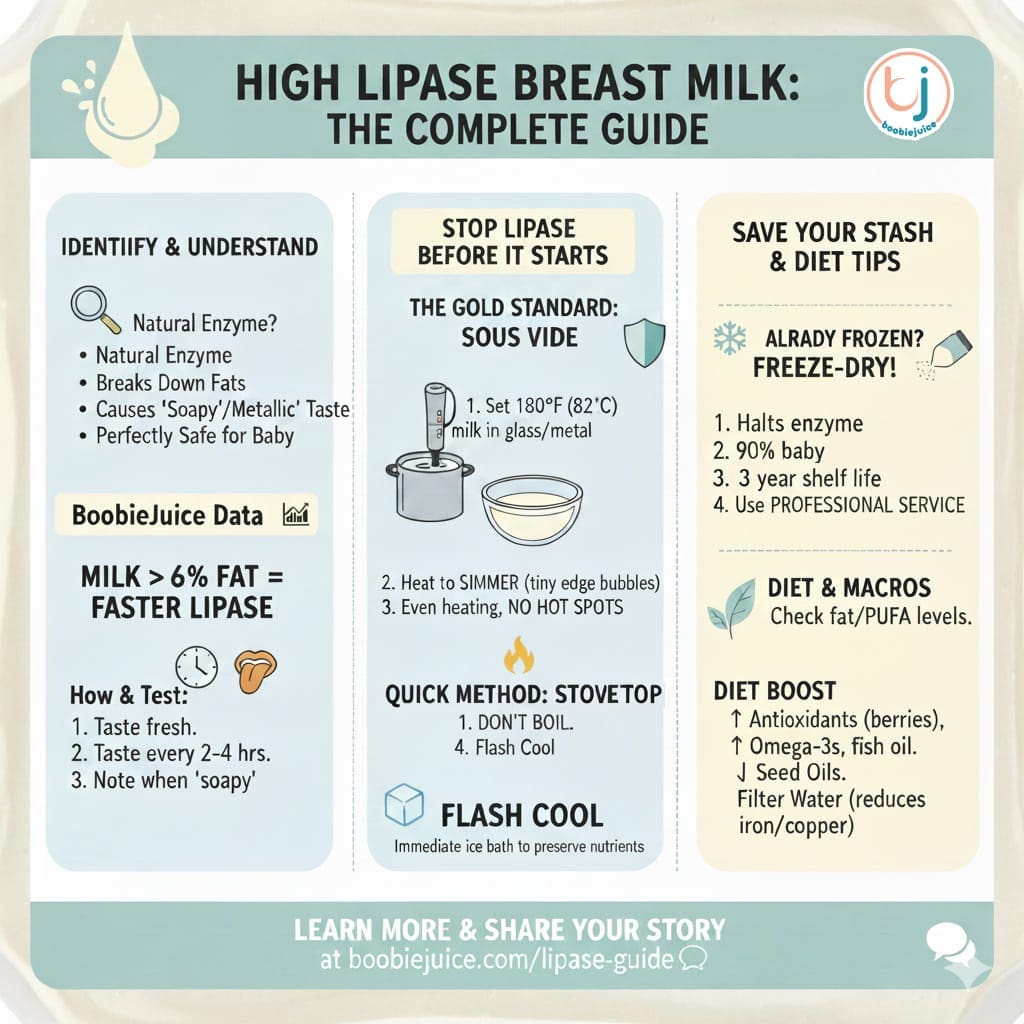
How to Test Your Milk for High Lipase
Before changing your entire routine, perform a “taste test”:
1. Pump a fresh bottle of milk.
2. Taste a small drop immediately.
3. Leave the bottle in the fridge and taste it every 2 to 4 hours.
Note when the “soapy” taste begins. This is your threshold, and you must heat-treat your milk before this time window closes.
The Solution: How to Scald Breast Milk (Step-by-Step)
Scalding is the only way to “deactivate” the lipase enzyme before it changes the flavor of your milk.
Step 1: Prep Your Equipment
Use a stainless steel pot or a specialized bottle warmer that reaches high temperatures. Ensure all parts are sterilized.
The Gold Standard: Scalding with a Sous Vide (Immersion Circulator)
The experts at BoobieJuice recommend for the most precise and even heating, using an immersion circulator, also known as a sous vide water bath.
Standard stovetop scalding can lead to “hot spots”—areas where the milk becomes too hot too quickly—which can degrade the nutritional quality of your breast milk. Using a water bath ensures a gentle, uniform temperature increase.
How to Sous Vide Scald Your Milk:
1. Set the Bath: Fill a large container with water and attach your immersion circulator. Set the temperature to 180°F (82°C).
2. Use Glass or Metal: Place your freshly expressed milk into a high-quality glass or stainless steel bowl (avoid plastic, as high heat can cause leaching).
3. The Water Bath: Carefully place the bowl into the water bath (ensure the water level is high enough to surround the milk but not spill inside).
4. Monitor for Precision: Because the water bath provides even heat distribution, you don’t have to worry about scorching the bottom of the milk. Once the milk hits the target temperature, remove it immediately.
Flash Cool: Just like the stovetop method, move the milk directly into an ice bath to lock in the nutrients and stop the lipase activity.
Why this matters: Precise temperature control preserves as many antibodies and nutrients as possible while still effectively deactivating the lipase enzyme.
Step 2: Flash Cool
Immediately remove the milk from the heat and place the container in an ice bath. Rapid cooling stops the cooking process and prevents bacterial growth.
Step 3: Store Safely
Once cooled, transfer the milk to your favorite storage bag and freeze immediately. Once scaled, learn how long you can store frozen breast milk in the freezer.
Tips for Refusal: What if My Baby Won’t Drink It?
If you already have a freezer stash of “soapy” milk, don’t throw it away! Try these strategies:
-
The 50/50 Rule: Mix half high-lipase milk with half freshly pumped milk.
-
Add Vanilla: One drop of alcohol-free vanilla extract can often mask the metallic scent (consult your pediatrician first).
-
Serving Temperature: Some babies are more likely to accept high lipase milk if it is served chilled rather than warm.
- Freeze-drying: Know to improve the taste and aroma of milk already impacted by lipase.
The Modern Alternative: Freeze-Drying Breast Milk
If you have a large “soapy” freezer stash already, or you simply don’t have time to scald every pumping session, freeze-drying (lyophilization) is a game-changer.
While traditional freezing allows the lipase enzyme to slowly continue breaking down fats, freeze-drying removes the water and puts the enzyme into a “dormant” state.
Why Freeze-Drying Works for High Lipase:
-
Stops the Clock: It halts the enzyme activity immediately, preventing the taste from getting any worse.
-
90% Success Rate: Studies and internal data from services show that about 90% of babies who refuse frozen milk will happily drink the same milk once it has been freeze-dried.
-
Saves Your Stash: Unlike scalding (which must be done before the milk tastes bad), freeze-drying can be done to milk that is already frozen, often making the flavor much more palatable for the baby.
-
Shelf Stability: It turns your milk into a powder that is shelf-stable for up to 3 years.
Mom-to-Mom Tip: You cannot safely freeze-dry breast milk at home using a standard dehydrator or freeze-dryer. To ensure the nutrients are preserved and the milk remains sterile, you should use a professional, FDA-registered and Gmp-Certified freeze-drying service that can also perform nutritional breast milk testing.
Can Macro Nutritional Testing Identify the Cause of High Lipase?
Many moms wonder if the “fattiness” of their milk is to blame for the soapy smell. While lipase is an enzyme that breaks down fat, having “high-fat milk” doesn’t necessarily mean you will have a lipase issue. However, macro nutrient testing can provide a clearer picture of your milk’s unique profile.
How Macronutrient Testing Works
Services that offer breast milk analysis test for:
-
Total Fat Content
-
Protein and Carbohydrates
-
Option: Fatty Acid Profiles (Specialty Testing required)
If your testing shows a very high concentration of polyunsaturated fatty acids (PUFAs)(specialty testing required), your milk may be more prone to rapid oxidation. When these fats oxidize, the lipase enzyme works faster, leading to that metallic or soapy taste much sooner than it would in milk with a different fat balance.
Can Diet Adjustments Help Lower High Lipase?
While high lipase is largely biological and hormonal, many mothers find that specific dietary shifts can “slow down” the enzymatic process or reduce the oxidative stress on the milk.
1. Increase Antioxidant Intake
Oxidation is a major trigger for the “off-flavor” in high lipase milk. Increasing your intake of antioxidants can help stabilize the milk:
-
Vitamin E & Vitamin C: Found in berries, leafy greens, and nuts.
-
Selenium: Found in Brazil nuts and seafood.
2. Monitor Your Fat Sources
Our internal data at BoobieJuice, along with community experiences, suggests that the types and sources of fats in your diet can play a role in how quickly lipase activity shows up in stored milk—especially in higher-fat samples (>6%).
Here are some practical dietary considerations to support more stable milk fats:
- Limit pro-inflammatory & easily oxidized fats — High intake of seed oils (like soybean, corn, sunflower, or other high-omega-6 sources) can contribute to more vulnerable polyunsaturated fats (PUFAs) in breast milk. These may oxidize faster during storage, potentially amplifying off-flavors (soapy/metallic) alongside lipase breakdown. Aim to moderate these while focusing on whole-food fat sources.
- Boost omega-3s for better fat stability — Prioritize DHA and EPA from high-quality sources like fatty fish (e.g., salmon, sardines), fish oil supplements, or algae oil (vegan-friendly). Omega-3s can improve the overall fatty acid profile of breast milk, potentially supporting more stable fat globules and reducing susceptibility to rapid changes during storage.
- Moderate overall fat intake if your milk tests very high (>6%) Key Things to take in account.
- Rapid changes in fatty acid composition: Multiple studies demonstrate that dietary fatty acids are transferred into breast milk quickly. For example:
- Changes in medium- and long-chain fatty acids appear within 8–10 hours after a meal or dietary shift.
- Specific fatty acids (like certain PUFAs) can increase significantly in milk within 6 hours of consumption, with peak effects around 10 hours.
- One study noted a lag time of about 6 hours between dietary intake peaks and milk changes for some fats.
- Even shorter-term effects observed: In colostrum (early milk), fat concentration increased by ~20% just 2 hours after a meal in one study. Another controlled trial showed alterations in triglycerides, cholesterol, and other components over 12 hours after high-fat or high-sugar meals.
- Diet swaps show quick shifts: A recent 2025 study found that swapping one food (e.g., beef for a plant-based substitute) altered the types of fats in breast milk in as little as 6 days, with total fat staying the same but profiles changing noticeably (e.g., lower long-chain PUFAs supporting brain development, higher saturated fats from certain sources).
- Correlations with recent intake: Reviews and observational data link maternal intake from the previous day or short periods to milk fatty acids (e.g., positive correlations for PUFAs, SFAs, and MUFAs with dietary levels). Fish/seafood intake boosts DHA/EPA quickly, while high seed oils or processed fats can shift profiles toward more vulnerable or pro-inflammatory types.
3. Check Your Water Supply
Sometimes, it isn’t the diet but the water. If your local water is high in iron or copper, these minerals can act as catalysts for the lipase enzyme. If you suspect this, try drinking filtered water for a week to see if your “threshold” (the time it takes for milk to turn soapy) improves.
The Fat-Lipase Connection: What Our Data Shows
At BoobieJuice, we’ve analyzed hundreds of samples from our pumping community, and a clear pattern stands out: breast milk with fat content over 6% often shows noticeably higher and faster lipase byproduct activity when stored.
In “extra fatty” milk, there’s simply more fat available for the naturally occurring lipase enzyme to break down. This leads to quicker production of free fatty acids, which can give pumped milk that characteristic soapy or metallic taste—sometimes as soon as 2–4 hours after expression.
Lipase is a helpful enzyme that pre-digests fats in breast milk, making them easier for babies to absorb (especially important for direct nursing). High-fat milk itself isn’t hard for babies to digest when fed fresh from the breast. The challenge comes with storage: the enzyme keeps working after pumping or freezing, breaking down fats faster in higher-fat samples and causing the flavor change sooner.
The good news? This milk is still perfectly nutritious and safe—many babies accept it without issue, and there are ways to manage it (like scalding before freezing or mixing batches).
This is just one piece of what our data is showing—thanks to everyone sharing their experiences!
What This Means for Your Routine
If your milk is on the higher end of the fat spectrum, you are essentially “running out of time” faster than other nursing mothers.
-
If your milk is >6% fat: You likely need to move to a “Flash-Scald” or “Sous Vide” process immediately after pumping, rather than waiting until the end of the day.
-
The “Fresh” Rule: For high-fat, high-lipase milk, even a few hours in the fridge can be the difference between a bottle your baby accepts and one they refuse.
The Verdict: Testing vs. Freeze-drying vs. Scalding
While macro testing and diet adjustments are excellent for overall health and understanding your milk, they are preventative.
-
If you need a fix today: The Sous Vide Scalding Method is your best bet.
- Frozen Milk taste & Aroma Fix: Freeze-dry your frozen Breast Milk with companies like BoobieJuice that specialize in lipase milk.
-
If you want a long-term solution: Macro testing can help you fine-tune your nutrition to potentially reduce the speed of lipase activity over time.